Zermatt · Switzerland
In the Shadow of Greatness
45° 58' 35" N·7° 39' 31" E
It is a place that reminds you how small you are.

There are few places in the world where arrival is as much a part of the experience as the destination itself. Long before the first glimpse of the Matterhorn, the journey to Zermatt begins to slow your pace. Cars are left behind in Täsch, replaced by a quiet train that winds steadily through the narrowing valley. Villages become smaller, roads disappear, and the mountains begin to close in. By the time the train glides into Zermatt station, the transition feels complete. Electric taxis hum almost silently through streets where horse-drawn carriages still carry luggage between hotels, church bells drift across the rooftops, and the scent of burning pine hangs in the cold mountain air. It is one of the rare resorts where modern life seems to pause without ever feeling nostalgic.
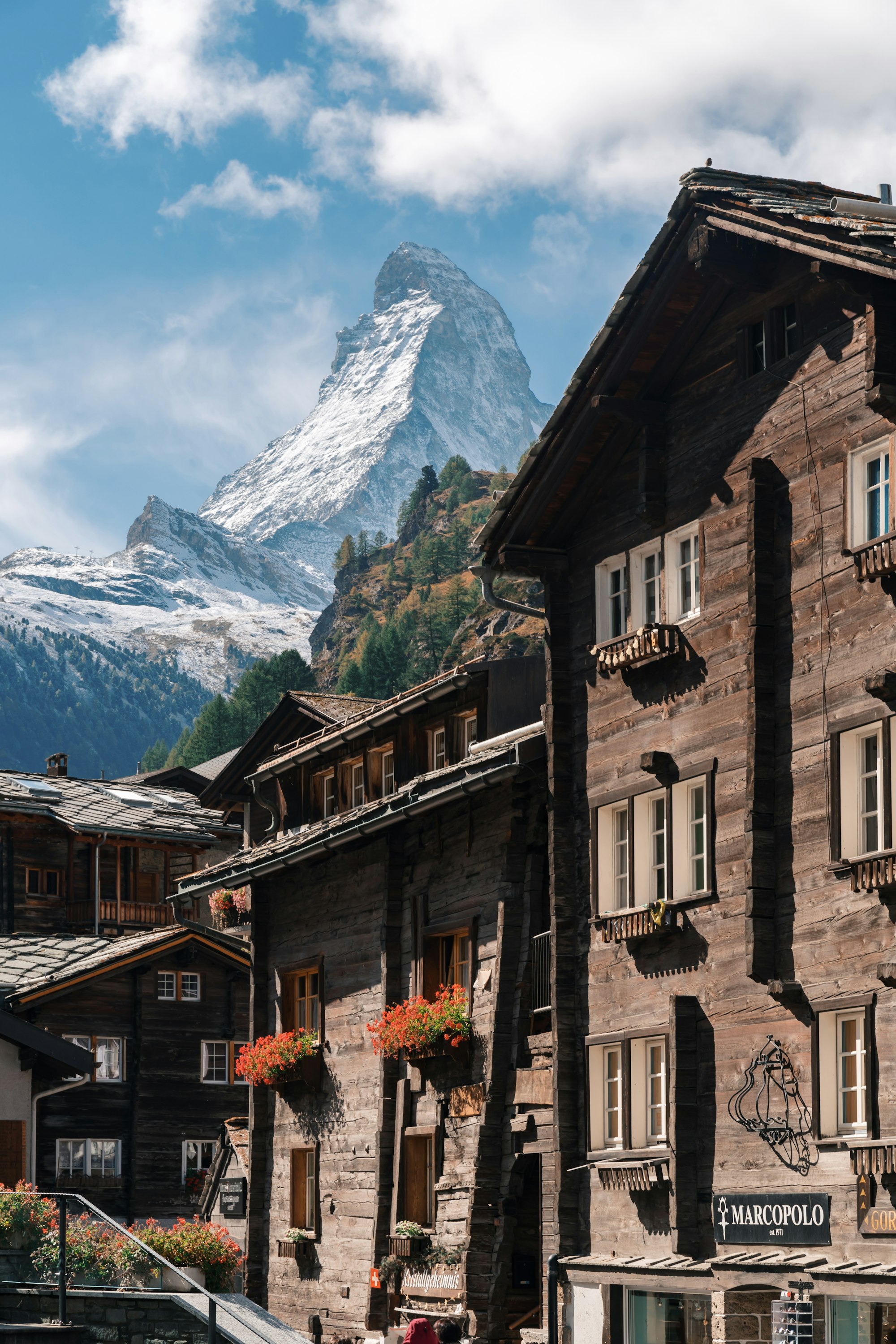
Then, almost inevitably, you look up. The Matterhorn is not gradually introduced. It dominates. Rising more than 4,400 metres above sea level, its unmistakable pyramid appears simultaneously improbable and entirely natural, as though it had been placed there to define not only the landscape but the identity of the entire valley. Photographs cannot prepare you for its scale. Nor can they explain the curious effect it has on those who spend time beneath it. Even after several days, visitors continue to glance skywards almost unconsciously, checking whether cloud has gathered around the summit or whether the first and last light of the day has transformed the mountain into something altogether different. The Matterhorn does not become familiar. It simply becomes part of your daily rhythm.
Many resorts are celebrated for their skiing. Zermatt is celebrated for something larger. It is a place that reminds you how small you are.
That may sound like an unusual quality to praise in a luxury destination, but it is precisely what makes Zermatt so distinctive. In an age when travel is often measured by experiences curated for our comfort, the village sits beneath a mountain that remains utterly indifferent to our presence. The Matterhorn has inspired painters, photographers, climbers and dreamers for more than a century, yet it has never become domesticated. It remains wild, dangerous and magnificent. Every aspect of Zermatt exists in conversation with it.
The village itself has evolved with extraordinary sensitivity. Unlike many Alpine destinations that expanded rapidly during the latter half of the twentieth century, Zermatt has managed to modernise without losing its essential character. Ancient timber barns, blackened by centuries of mountain weather, stand alongside some of Europe's finest hotels. Narrow lanes twist between historic buildings where geraniums spill from balconies in summer and deep snow gathers beneath carved eaves in winter. Luxury has arrived gradually rather than abruptly, allowing the village to retain the atmosphere of a genuine mountain community rather than becoming a stage set for tourism.
That authenticity is reinforced by the absence of conventional traffic. The decision to remain largely car-free is often described as an environmental policy, but it has had a far broader impact than that. Without the constant presence of engines, the sounds of the village become remarkably subtle. Boots crunch on fresh snow. Church bells echo through the valley. Conversations drift from café terraces. Even in the height of the season, Zermatt feels unexpectedly peaceful. It is a reminder that tranquillity can itself be a form of luxury.
The skiing reflects the same balance between ambition and restraint. Stretching across the Swiss and Italian border, the Matterhorn Ski Paradise offers one of Europe's highest and most snow-sure networks of pistes. High-altitude glaciers provide skiing well beyond the traditional season, while beautifully groomed cruisers descend towards the village through forests and open alpine bowls. Intermediates will find almost endless opportunities to cover distance, moving effortlessly between Switzerland and Italy before stopping for lunch on whichever side of the border feels most appealing that day. Expert skiers, meanwhile, discover a mountain that rewards patience rather than aggression. Off-piste terrain exists in abundance, but it demands respect. Like so much in Zermatt, the emphasis is not on spectacle but judgement. Local mountain guides are revered not simply for their technical ability but for their understanding of terrain, weather and history. To ski with one is to appreciate that these mountains are not merely recreational landscapes but working environments whose rhythms have been studied across generations.
The culture of mountaineering runs deeply through the village. Long before skiing became the primary reason to visit, Zermatt was attracting climbers drawn by the great peaks of the Pennine Alps. The first ascent of the Matterhorn in 1865 transformed the village forever, bringing both triumph and tragedy in equal measure. The story remains woven into local identity, not as a marketing narrative but as a reminder that these mountains demand humility. Visitors need not climb a single peak to feel its influence. It exists in the museums, the guiding tradition, the quiet respect shown towards the landscape and the understanding that nature always has the final word.
Hospitality in Zermatt reflects that same quiet confidence. The village contains some of Switzerland's most celebrated hotels, many of which have welcomed generations of the same families for decades. Service here rarely seeks attention. Instead, it is characterised by consistency, warmth and remarkable professionalism. Guests are remembered rather than merely recognised. Favourite tables reappear without request. Returning visitors discover that seemingly insignificant preferences have not been forgotten. It is luxury expressed not through extravagance but through genuine attentiveness.
The culinary scene has matured in much the same way. Traditional mountain restaurants serving rösti, fondue and locally cured meats sit comfortably alongside Michelin-starred dining rooms where Swiss produce is interpreted with contemporary precision. Yet even the finest meals rarely lose sight of their surroundings. Menus remain rooted in the Alps, drawing upon local cheeses, game, herbs and wines that reflect the remarkable diversity of the Valais. There is little interest in chasing international fashions when the ingredients arriving from the surrounding mountains are already exceptional.
As the afternoon begins to fade, the light performs its daily transformation. The summit of the Matterhorn catches the last warmth of the sun while the village below slips quietly into shadow. Skiers descend the final pistes, terraces empty and smoke begins to curl from chimney pots across the valley. It is one of the most photographed mountains in the world, yet no photograph quite captures this particular moment. The scale, the silence and the changing light combine to create something deeply personal. Conversations pause almost instinctively as people look towards the summit one final time before dinner.
Perhaps that is Zermatt's greatest achievement. It understands that true luxury is not always about indulgence. Sometimes it is about perspective.
The modern world encourages us to feel important. We are invited to believe that every experience should revolve around our own comfort, our own schedules and our own ambitions. Zermatt quietly suggests the opposite. Here, the mountain remains the principal character. Visitors are simply fortunate enough to spend time in its company. That is why people return.
Not merely to ski exceptional slopes or stay in remarkable hotels, but to rediscover a rare sensation: the feeling of standing beneath something infinitely older, larger and more enduring than ourselves. In a world increasingly shaped around convenience, Zermatt reminds us that awe remains one of travel's greatest luxuries.
From Inside Oxford Ski Company’s Little Black Book
Don't missSunrise over the Matterhorn from Sunnegga; lunch overlooking the Italian border; the historic streets of the old village after dark; skiing into Cervinia for a long Italian lunch; and an afternoon at the Matterhorn Museum to understand the valley's mountaineering heritage.
Three-day strategyDedicate your first day to the Swiss side of the mountain, your second to crossing into Italy, and your third to skiing with a guide before lingering in the village rather than rushing for the train home.
The Oxford Ski Verdict
Zermatt is more than one of the world's great ski resorts. It is one of the few destinations where landscape, history and hospitality exist in complete harmony. The skiing is exceptional, the hotels among Europe's finest, but neither defines the experience. The mountain does. Everything else exists in its shadow, and is all the better for it.
Properties in Zermatt
Featured Chalets and Hotels
Experience Zermatt
Speak with our specialists to begin planning your winter in Zermatt.